This link has been shared online for a while now, and I think it has a powerful message. Our choice of words is critical in expressing our thoughts and feelings, and also in the way we communicate to others. This does emphasize how, when we choose our words carefully, the impact they can have. I think it is a good example of being mindful of the way we express ourselves. What do you think? Do the words we use in our conversations with our own children and our students have an impact we may not realize?
Posted in MIndfulness | Tagged impact, speech | 4 Comments »
It is faith that moves mountains, not facts. Facts do not give birth to faith. Faith needs a story to sustain it – a meaningful story that inspires belief in you and renews hope that your ideas do indeed offer what you promised. Genuine influence goes deeper than getting people to do what you want them to do. It means people pick up where you left off because they believe.
Annette Simmons
I found this quote in a book I am reading and as I have thought about it quite a bit over the past week I believe it has implications for all us in the cohorts as we move forward with our culminating projects. I have more questions than answers, as usual and here are some thoughts as a result.
Do we begin to look at professional learning as a leap of faith for those who resist pedagogical changes in classrooms especially if it involves the use of technology? In the above quote a this stands out for me – a meaningful story that inspires belief that our ideas do indeed offer what is promised.
How often when professional learning is offered is it presented as a how to, not a why to? Would having a story to tell around the why be helpful? Incorporating our story of the tool, our story of our own changes as a result of use, and our students, help to instill faith – influence people enough to believe what we are asking is worth a try?
We want them to pick up where we leave off, do we need to change our approach to incorporate meaningful stories to inspire belief?
Image Source: Flickr user kodomut

Posted in learning | Tagged learning, sharing, stories | Leave a Comment »
DoSomething.org has teamed up with Students Rebuild – Paper Cranes for Japan, to raise money for the crisis in Japan. I am writing about this today because we talk of collective action during the year, bringing people together, students in particular to work for the greater good of something. This project, is wonderful because students do not need a car, solicit donations, or depend on an adult to be involved and understand they can make a difference in the world.
According to legend, anyone who folds a thousand paper cranes, which are sacred creatures in Japanese culture, will be granted a wish by a crane. With a goal to collect 100,000 origami cranes from young people to represent wishes of support and healing, the challenge hopes to raise $200,000 for the reconstruction of a youth facility by the Japanese team from Architecture for Humanity.
Students will be able to follow the efforts of Architecture for Humanity on their web site to see how their donations are being used in the rebuilding effort. And after 100,000 cranes are submitted, they will be turned into a woven art installation – a symbolic gift from students around the world to their Japanese counterparts.
On the student rebuild page there are links to a video tutorial on how to make the cranes, and also instructions how to request mailing labels for the cranes and where to send them.
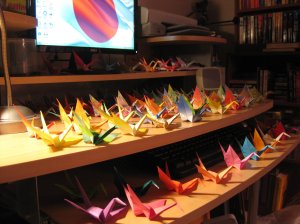 Image Source Ellis Aquarius Powell
Posted in Social Good | Tagged collectiveaction | Leave a Comment »
Archives
- April 2011
- March 2011
- February 2011
- January 2011
- November 2010
- March 2010
- February 2010
- December 2009
- September 2009
- February 2009
- December 2008
- November 2008
- October 2008
- September 2008
- July 2008
- June 2008
- May 2008
- April 2008
- March 2008
- February 2008
- January 2008
- December 2007
- November 2007
- October 2007
- September 2007
- August 2007
- July 2007
- June 2007
Recent Comments
- Are You Using Twitter Effectively For Your Personal Learning? – Sue Waters on Open staff development session 2
- Can The Passion Quilt Meme Be Brought Together? – Sue Waters on Meme: Passion Quilt
- Can The Passion Quilt Meme Be Brought Together? – Sue Waters on Meme: Passion Quilt
- probate lawyer las vegas on What classrooms look like
- Carol Ryan on My thoughts for Christmas
Cluster Map
-

Twitter Updates
Tweets by robinellisInfo Sessions

PLPeeps


 Connecting Through Conversations